Chapter 4 Expressions
4.1 Fundamentals
Basic Concepts
- When we overload an operator, the meaning of it - including the type of operands and the result - depends on how it is defined. However, the number of operands and the precedence and associativity cannot be changed.
- Every expression in C++ is either an rvalue or an lvalue. When we use an object as an rvalue, we use the object’s value. When we use an object as an lvalue, we use the object’s identity (location in memory).
- We can use an lvalue when an rvalue is required, but we cannot use an rvalue when an lvalue is required. The only exception: an rvalue reference can only be bound to an rvalue (section 13.5).
constvariables are still lvalues - some operators (e.g. assignment) requires a non-constlvalue as the left-hand operand.
- When we apply
decltypeto an expression, the result is a reference type iff the expression yields an lvalue.
Precedence and Associativity
- Operands of operators with higher precedence group more tightly than operands of operators at lower precedence. Associativity determines how to group operands with the same precedence.
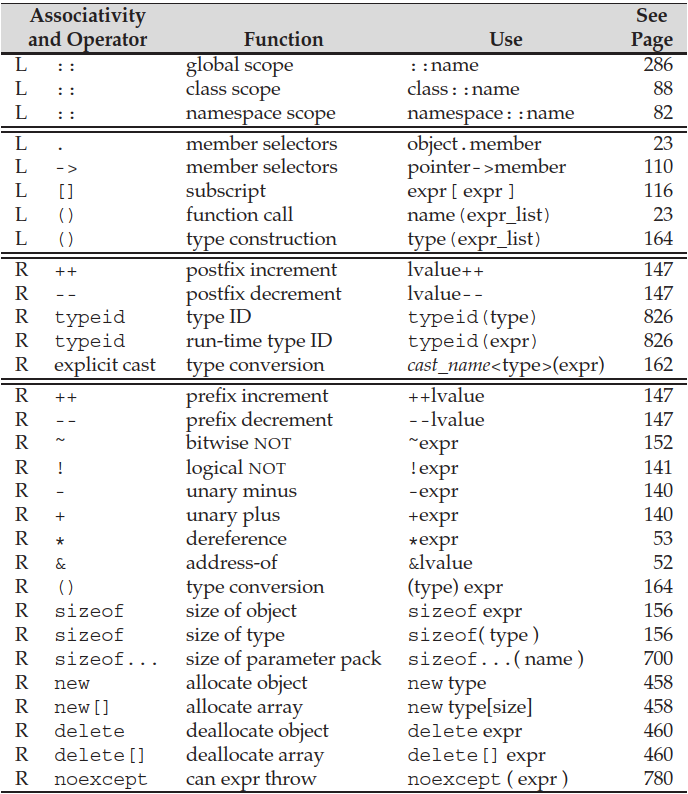
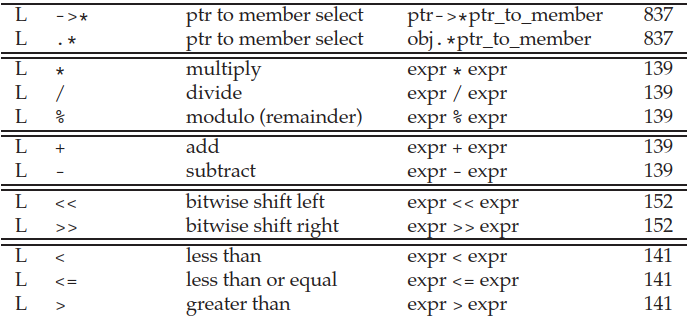
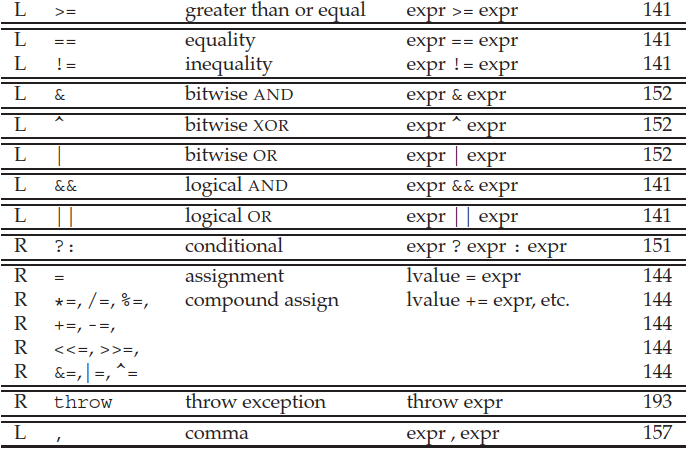
- Notes:
- For
noexceptoperator (not function specifier), refer to section 18.1. - For
typeid, refer to section 19.2. - For pointer to member operators (
.*,->*), refer to section 19.4.
- For
Order of Evaluation
- Precedence and associativity say nothing about the order in which operands are evaluated.
- For operators that do not specify evaluation order, it is an error for an expression to refer to and change the same object - undefined behavior.
- Four exceptions: logical AND
&&, logical OR||, conditional? :, comma,.
- Four exceptions: logical AND
cout << i << " " << ++i << endl;  // error
f() + g() * h() + j();            // error if some functions affect the same object
4.2 Arithmetic Operators
- Unary arithmetic operators (
+,-) have higher precedence than multiplication and division operators (*,/,%), which have higher precedence than binary addition and subtraction operators (+,-). They are all left associative. - The operands and results of these operators are rvalues.
- Operands of small integral types are promoted, and both operands may be converted to a common type (section 4.11). Type promotions happen when an operator is evaluated.
- Any integer type smaller than
intwill always be promoted to at leastint/unsigned int(section 4.11).
- Any integer type smaller than
- Note:
boolvalues should not be used for computation.
bool b = true;
bool b2 = -b;  // b2 is true: promoted to int 1, negated to -1, converted back to bool
- Meaning of operators:
/computes the quotient. The quotient is rounded toward zero in C++11 standard.(-m)/nandm/(-n)are always equal to-(m/n).
%computes the remainder. The operands to%must have integral type. Ifnis nonzero, then(m/n)*n + m%n == m:m%nhas the same sign asm.m%(-n)is always equal tom%n, and(-m)%nis always equal to-(m%n).
4.3 Logical and Relational Operators
- The logical operators take operands of any type that can be converted to
bool. Except for!, all of them are left associative. - The operands and result are rvalues.
- Short-circuit evaluation: in
&&and||, the right operand is evaluated iff the left operand does not determine the result. - Relational operators cannot be chained together: in
a < b < c, a boolean is compared withc.
4.4 Assignment Operators
- Assignment operators are right associative. Assignment has relatively low precedence.
- The left-hand operand must be a modifiable lvalue (non-
constvariable for assignment, declaration for initialization), and the result is an lvalue referring to the left-hand operand. - Under C++11, we can use a braced initializer list for assignment.
- For built-in types, at most one value can be contained.
- For class types, the following choices are available:
- For aggregate classes (section 7.5), each field in the initializer list is copied to the corresponding member of the object.
- The assignment operator taking an initializer list will be called if it exists. Priority is given to the best type match. Type narrowing conversions are not allowed.
- If no such operator exists, the compiler will attempt to use a constructor: the constructor that takes an initializer list will be called if it exists; otherwise, the compiler will try to find a constructor that matches the number and types of the elements in the initializer list.
- For any type, the initializer list can be empty: a value-initialized temporary is generated and assigned to the left-hand operand.
class Base {
 public:
  Base(int i, int j);                       // 5th choice
  Base(initializer_list<double> lst);       // 4th choice
  Base(initializer_list<int> lst);          // 3rd choice
  operator=(initializer_list<double> lst);  // 2nd choice
  operator=(initializer_list<int> lst);     // 1st choice
  operator=(int i, int j);  // error: assignment operator must take exactly one parameter
}

Base b = {1, 2};
Base b = {1, 2.2};     // those with initializer_list<int> are not considered
- When we use the compound assignment (e.g.
+=), the left-hand operand is evaluated only once. If we use an ordinary assignment, the left-hand operand is evaluated twice.
4.5 Increment and Decrement Operators
- Increment operators require lvalue operands. The prefix operators return the object itself as an lvalue, while the postfix operators return a copy of the object’s original value as an rvalue.
- Advice: use postfix operators only when necessary. The prefix version avoids unnecessary work.
*ptr++is a widely used idiom: it is equivalent to*(ptr++).- Avoid misusing these operators in compound expressions where their order of evaluation is important.
*ptr = toupper(*ptr++);              // undefined: order of evaluation is unspecified

*ptr = toupper(*ptr); ptr++;         // if left-hand side is evaluated first
*(ptr + 1) = toupper(*ptr); ptr++;   // if right-hand side is evaluated first
4.6 The Member Access Operators
- The member access operators (
.,->) have very high precedence (higher than increment/decrement and dereference). - The arrow operator requires a pointer (rvalue) operand and yields an lvalue. The dot operator yields an lvalue iff its left operand is an lvalue.
- The arrow operator actually returns a pointer to an object. Refer to section 14.7 for more details.
4.7 The Conditional Operator
- The two expressions in the conditional operator must have the same type, or types convertible to a common type.
- The expressions are not evaluated until the operator is evaluated, and only one of them is evaluated.
- The result is an lvalue iff both expressions are lvalues or both are convertible to a common lvalue type.
- Conditional operators can be nested without parentheses: they are right associative.
- Conditional operators have fairly low precedence: parenthesize them when used in expressions with other operators.
4.8 The Bitwise Operators
- The bitwise operators take operands of integral type or
bitset(section 17.2) to test and set individual bits.- Any integer type smaller than
intwill always be promoted to at leastint/unsigned int(section 4.11). - Both signed and unsigned types are allowed. However, operating on signed types with negative values is machine dependent (except for left shift) - use unsigned types instead.
- Any integer type smaller than
- For bitwise shift operators, the right-hand operand must not be negative and must be less than the number of bits in the left-hand operand. Otherwise, the operation is undefined.
- The right-shift operator inserts zeros on the left for unsigned types (logical right shift). For signed types, the result is implementation defined (arithmetic or logical right shift).
- Bitwise shift (aka IO) operators are left associative and have midlevel precedence: lower than arithmetic operators but higher than relational operators.
cout << 10 + 42;    // ok
cout << (10 < 42);  // ok
cout << 10 < 42;    // error: (cout << 10) < 42
4.9 The sizeof Operator
- The
sizeofoperator returns a constant expression of typesize_t. It takes one of two forms:sizeof exprorsizeof (type). - The
sizeofoperator does not evaluate its operand. - Under C++11 standard, we can use the scope operator to ask for the size of a class member without an object:
sizeof ClassName::member. sizeofan array is the size of the entire array. It doesn’t convert the array to a pointer.sizeofastringorvectorreturns only the size of the fixed part (no dynamic allocated elements).
4.10 Comma Operator
- The left-hand expression is evaluated but its result is discarded. The right-hand expression is evaluated and its result is returned.
- The result is an lvalue iff the right-hand expression is an lvalue.
4.11 Type Conversions
- Two types are related if there is a conversion between them. We can use an object or value of one type where an operand of the related type is expected - implicit conversion will be performed by the compiler.
- The implicit conversions among arithmetic (built-in) types are defined to preserve precision.
- When Implicit conversions occur:
- In most expressions, values of integral types smaller than
intare first promoted to an appropriate larger integral type. - In conditions, non-
boolvalues are converted tobool. - In initializations/assignments, the initializer/right-hand operand is converted to the type of the variable (left-hand operand).
- In arithmetic and relational expressions, the operands are converted to a common type.
- In function calls, the arguments are converted to the types of the corresponding parameters.
- In most expressions, values of integral types smaller than
The Arithmetic Conversions
- The integral promotions happen first. They always convert small integral types to a larger integral type (at least
int). Only the size matters:- The types
bool,char,signed char,unsigned char,short, andunsigned shortare promoted tointif all values in that type fit in anint(not related to the actual value; not related to whether signed or not). Otherwise, the value is promoted tounsigned int. - Larger
chartypes (wchar_t,char16_t,char32_t) are promoted to the smallest type ofint,unsigned int,long,unsigned long,long long, orunsigned long longthat can hold all the values of the original type.
- The types
- Afterwards, if the operands have different signedness:
- If the unsigned type (
unsigned int) is the same as or larger than the signed type (int), the signed type is converted to the unsigned type. - Otherwise, the result is machine dependent: if all values in the unsigned type fit in the signed type (not related to the actual value), then the unsigned operand is converted to the signed type; otherwise, the signed operand is converted to the unsigned type.
- Example:
longandunsigned int. Iflongandinthave the same size, thenlongwill be converted tounsigned int. Iflonghas more bits, thenunsigned intwill be converted tolong.
- Example:
- If the unsigned type (
- In expressions mixing floating-point and integral types, the integral type is always converted to the (larger) floating-point type. Precision is not prioritized.
- Example:
floatandlong long-long longis converted tofloat.
- Example:
bool flag;    char cval;
short sval;   unsigned short usval;
int ival;     unsigned int uival;
long lval;    unsigned long ulval;
float fval;   double dval;

3.14159L + 'a';  // 'a' promoted to int, then that int converted to long double

cval + fval;     // cval promoted to int, then that int converted to float
sval + cval;     // sval and cval promoted to int

usval + ival;    // promotion depends on the size of unsigned short and int
uival + lval;    // conversion depends on the size of unsigned int and long
Other Implicit Conversions
- Array to pointer conversions are not performed when an array is used with
decltypeor as the operand of&,sizeof, ortypeid(section 19.2), or when we initialize a reference with it. - Pointer conversions:
- A constant integral value of 0 and the literal
nullptrcan be converted to any pointer type. - A pointer to any non-
consttype can be converted tovoid *, and a pointer to any type can be converted toconst void *. - The name of an array can be converted to a pointer to the array’s element type (section 3.5).
- The name of a function can be converted to a pointer to the function (section 6.7).
- A base-class pointer (or reference) can be bound to a derived-class object (section 15.2).
- A constant integral value of 0 and the literal
- Conversions to
bool: compare to zero for arithmetic types, compare tonullptrfor pointers, and call conversion tobool(operator bool() const) for class types. - A pointer to a non-
consttype can be converted to low-levelconstpointer type. The reverse conversion does not apply.
Explicit Conversions
Casts are inherently dangerous constructs.
- Named casts:
static_cast(value conversion, allow potential loss of precision): not only built-in types, but also class types (using conversion functions or constructors, e.g.string) are supported.dynamic_cast(run-time type identification used in polymorphism, section 19.2)const_cast(cast away/add low-levelconst- but writing to aconstobject is undefined)reinterpret_cast(low-level reinterpretation of the bit pattern, dangerous): only pointer-pointer, reference-reference, and pointer-integer conversions are allowed.
- Old-style casts (
type (expr),(type) expr) does the same conversion as one of these: trystatic_castandconst_cast, and thenreinterpret_cast.