Chapter 14 Overloaded Operations and Conversions
Basic Concepts
- Except for the overloaded
operator(), an overloaded operator may not have default arguments. - A member operator function has one less explicit parameter than the operator has operands (the first operand is bound to
this). The left-hand operand must be an object of the class (no conversions). - An operator function must either be a member of a class or have at least one parameter of class type. This means built-in types cannot have overloaded operators.
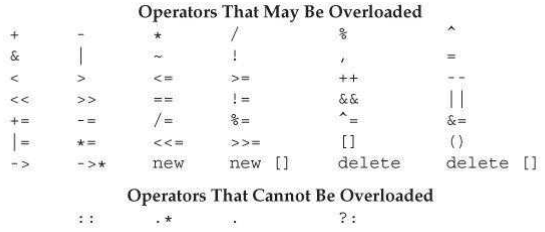
+,-,*,&can serve as both unary and binary operators. Both can be overloaded.- Operators that can or cannot be overloaded:
- An overloaded operator function can be called directly:
operator+(data1, data2),data1.operator+=(data2). - The overloaded versions do not preserve operand-evaluation guarantees: no short-circuit evaluation properties in
&&and||. These operands with built-in meanings should not be overloaded. - Whether to define an operator a member or an ordinary nonmember function:
=,[],(),->must be members.- Compound assignment operators and operators that change the state of the object ought to be members.
- Symmetric operators (even with mixed types, e.g. adding
intanddouble) should be defined as ordinary nonmember functions.
Input and Output Operators
- Must be nonmember functions.
- Output operator:
ostream &operator<<(ostream&, const T&).- Minimal formatting: allow users to control the details.
- Usually declared as friends.
- Input operator:
istream &operator>>(istream&, T&).- Rather than checking each read, we check once after reading all the data at once and before using those data: directly use the
istreamobject as the condition. - Ensure the object should be in a usable state, not in an intermediate state.
- An input operator may set
failbitto indicate errors.
- Rather than checking each read, we check once after reading all the data at once and before using those data: directly use the
Arithmetic and Relational Operators
- Operands should be references to
const. - The generated value should be distinct from either operand.
- Classes that define both an arithmetic operator and the related compound assignment ordinarily ought to implement the arithmetic operator by using the compound assignment (not the other way around).
- Definitions of
==and<operators should be consistent if both exist: if two objects are!=, then one object should be<the other.
Assignment Operators
- Assignment operators are not limited to copy- and move-assignment. For example,
initializer_listcan be used to assign a vector.
Subscript Operator
- The subscript operator accepts a parameter of
std::size_tand returns a reference to the element. - Usually both
constand nonconstversions are defined.
Increment and Decrement Operators
- Classes that define increment or decrement operators should define both the prefix and postfix versions. These operators usually should be defined as members.
- Declaration and definition:
- Prefix operators:
T &operator++(). A reference to*thisis returned. - Postfix operators:
T operator++(int). Save the current state in an object and return.
- Prefix operators:
- They can be call explicitly: to call the postfix version, a value must be passed.
Member Access Operators
- The dereference (
*) and arrow (->) operators are often used in classes that represent iterators and in smart pointer classes.- Dereference:
T &operator*() const. - Arrow:
T *operator->() const.
- Dereference:
- The arrow operator never loses its fundamental meaning of member access. When we overload arrow, we change the object from which arrow fetches the specified member. We cannot change the fact that arrow fetches a member.
ptr->memis equivalent to:- Case 1:
ptris a built-in pointer:(*ptr).mem. - Case 2:
ptris a class object:ptr.operator->()->mem. Specifically, the result ofpoint.operator->()is used to fetchmem. If it returns a pointer (address), then it falls back to case 1. Otherwise it must be an object (recursively apply case 2).
- Case 1:
Function-Call Operator
- Objects of classes that define the call operator are referred to as function objects. Such objects “act like functions” because we can call them.
- Function objects are most often used as arguments to generic algorithms.
- Lambdas: the compiler translates lambda expressions into an unnamed function object (the generated function-call operator is a
constmember function unlessmutable).- Classes generated from a lambda expression have a deleted default constructor, deleted assignment operators, and a default destructor. Whether the class has a defaulted or deleted copy/move constructor depends in the usual ways on the types of the captured data members (same as in ordinary classes).
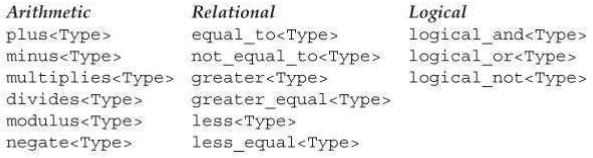
- The standard library defines a set of operator classes for creating function objects.
- They can be used to override the default operator in algorithms.
- The library function objects work for pointer comparation (normally, two pointers cannot be compared).
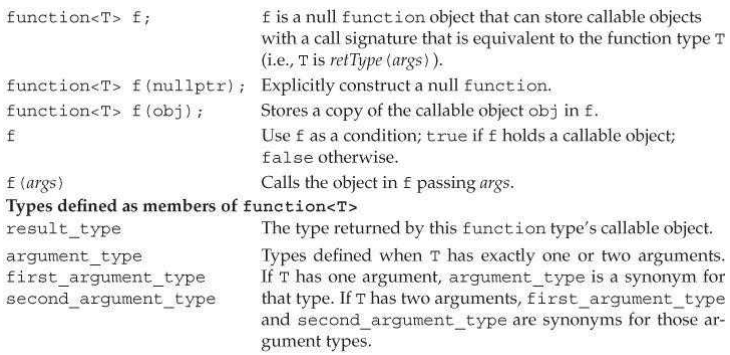
- A callable object has a type specific to the class. However, two callable objects with different types may share the same call signature: return type and argument types. A call signature corresponds to a function type.
funtiontypes (defined infunctional) can be used to store any callable object with a common call signature. The template accepts the corresponding function type to create the function class type.- The
functiontype overloads the call operator: it takes its own arguments and passes them to the stored callable object. - Assigning an overloaded function to a
functionobject will cause ambiguity. We can use an intermediate function pointer or a lambda function to resolve it.
- The
Overloading, Conversions and Operators
- Converting constructors and conversion operators define class-type conversions. Such conversions are also referred to as user-defined conversions.
- Conversion operator:
operator T() constconverts the object to typeT.Tcan be of any function return type other thanvoid.- In the declaration,
operator Tis the function name, and there is no return type. - An implicit user-defined conversion can be preceded or followed by a standard (built-in) conversion. For example,
si + 3.14implicitly convertssitoint, and it is converted todoubleusing the built-in conversion. - Conversion operators can yield surprising results:
cin << nperforms left-shift.
- In the declaration,
- Declaring the conversion operator as
explicitwill suppress implicit conversions. Onlystatic_castcan be used to do the conversion with one exception: used as a condition (if/loop/condition expression, logical operands).- Conversion to
boolis usually intended for use in conditions. As a result,operator boolordinarily should be defined asexplicit.
- Conversion to
- Ambiguity: multiple conversion paths may occur:
- Mutual conversions (constructor in A and conversion in B). Only explicit function calls are allowed:
b.operator A(),A(b). - Built-in arithmetic type conversion is involved. When two user-defined conversions are used, the rank of the standard conversion, if any, preceding or following the conversion function is used to select the best match. If they have the same rank, ambiguity occurs.
- Overloaded functions take parameters that differ by class types that define the same converting constructors. If two (or more) user-defined conversions provide a viable match, the conversions are considered equally good. The rank of any standard conversions that might or might not be required is not considered.
- Mutual conversions (constructor in A and conversion in B). Only explicit function calls are allowed:
// Example of built-in type conversion.
struct A {
	A(int = 0);               // usually a bad idea to have two
	A(double);                // conversions from arithmetic types
	operator int() const;     // usually a bad idea to have two
	operator double() const;  // conversions to arithmetic types
	// other members
};

void f2(long double);
A a;
f2(a);     // error ambiguous: f(A::operator int())
		   //               or f(A::operator double())
long lg;
A a2(lg);  // error ambiguous: A::A(int) or A::A(double)
short s = 42;
A a3(s);   // uses A::A(int)
           // promoting short to int is better than converting short to double
// Example of overloaded functions.
struct C {
	C(int);
	// other members
};
struct D {
	D(int);
	// other members
};
struct E {
	E(double);
	// other members
};

void manip(const C&);
void manip(const D&);
manip(10); // error ambiguous: manip(C(10)) or manip(D(10))

void manip2(const C&);
void manip2(const E&);
manip2(10); // error ambiguous: two different user-defined conversions could be used
- All overloaded operators will be considered when we use the operator (no order, no overloading):
- Ordinary nonmember versions of that operator.
- Overloaded versions of the operator defined by that class.
- Built-in versions of the operator.
class SmallInt {
	friend SmallInt operator+(const SmallInt&, const SmallInt&);
public:
	SmallInt(int = 0); // conversion from int
	operator int() const { return val; } // conversion to int
private:
	std::size_t val;
};

SmallInt s1, s2;
SmallInt s3 = s1 + s2; // uses overloaded operator+
int i = s3 + 0;        // error: ambiguous